

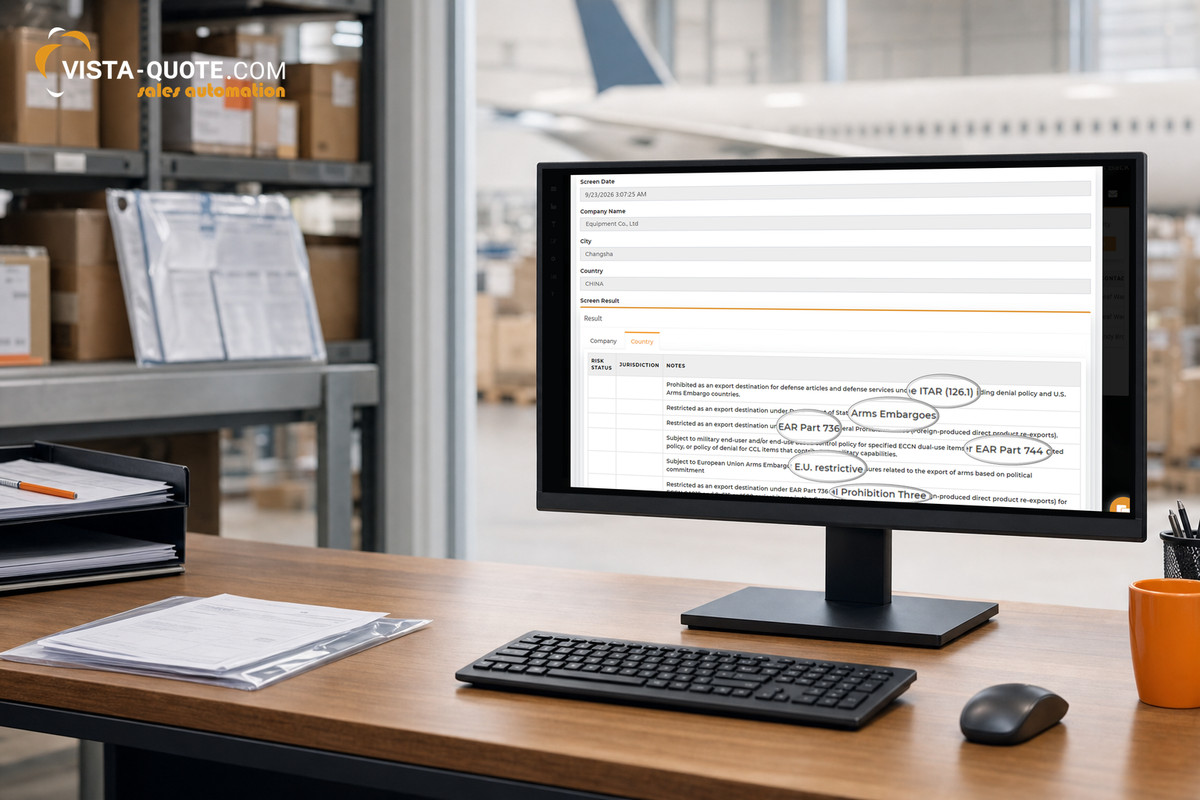
An incoming request for quote (RFQ) should not become a full sourcing and pricing exercise before your team knows whether a transaction party needs closer review. In international aviation parts sales, a request for a quote might connect a purchaser, consignee, intermediary, destination, and end user. Restricted third-party screening information is most useful when the RFQ is received, and the next action is still easy to control.
Reordering the process can help protect resources by letting the person handling the request spot a potential concern before researching inventory, contacting suppliers, confirming trace, estimating freight, or building a quote. The screening result does not make the compliance decision on its own, but it gives your team a proactive starting point for its own review and escalation process.
International Aviation RFQs Connect More Than One Company
Aviation parts move through commercial relationships that cross company and national boundaries. The U.S. International Trade Administration estimates that South Korea exported about $2.964 billion in aviation parts and components in 2024 while importing about $3.516 billion. The figures, based on Korea Aerospace Industries Association data, describe just one case, but they still show how a single aviation market can be both a major source and a major customer for parts.
Two-way relationships are important factors in RFQ fulfillment considerations. A familiar company might serve a different supply chain function, a request could involve a new consignee, or a buyer may be part of a longer commerce chain. The RFQ’s associated country provides useful context, but it doesn’t cover all parties or responsibilities involved.
The commercial stakes are substantial. IATA estimates that aviation supply-chain issues cost airlines more than $11 billion in 2025, including $1.4 billion in extra spares inventory. Those figures don’t include quoting systems or export screening. They reinforce why parts inquiries attract urgent attention and why that attention should start with the right business context.
Restricted-Party Screening Belongs Near the First Sales Decision
Export screening is broader than checking the final recipient’s name. The U.S. Bureau of Industry and Security explains that restrictions can apply when a listed party is the applicant, purchaser, or consignee, not only the end user or recipient. BIS guidance for freight forwarders also recommends screening known transaction parties against the Consolidated Screening List.
The Consolidated Screening List brings together screening lists maintained by the U.S. Departments of Commerce, State, and the Treasury. That structure is one reason a screening result should be treated as a decision input rather than just a country check. A potential match requires the review outlined by your organization’s procedures; a straightforward name search alone does not determine classification, licensing, destination, end-use, or other obligations.
Delayed Due Diligence Can Lead to Wasted Sales Resources
Aviation quoting can require several pieces of work before a price is ready. Someone may need to confirm inventory, locate outside supply, review condition and trace, check the requested quantity, estimate lead time, and account for freight or other charges. Learning that a transaction requires additional review after the work is complete interrupts the process in motion and causes information to be sent back through the organization.
Proactive restricted-party screening doesn’t eliminate these responsibilities, but it can help improve workflow and resource efficiency. The person receiving the RFQ can see that a review might be necessary while the request is still easy to pause, route, or discuss. This establishes a clear boundary between accepting an inquiry and dedicating more sales effort.
This also affects customer communication. If a request must pause for an unexpected review, the salesperson can recognize that need before setting expectations based on sourcing work that may not yet be relevant. The team can then handle the RFQ through its own process and communicate from a more informed position.
How Proactive Restricted-Party Screening Can Support Efficiency
A restricted-party screening result at the start helps answer whether to continue under the normal quoting process or involve the appropriate internal reviewer before work continues. Sales teams no longer have to rely on memory or personal judgment to decide when to start screening; instead, they can now have a clearer reference point to apply their established policy.
Time spent sourcing a part or preparing a detailed response has value. When a request needs attention, identifying that requirement early can help reduce avoidable work and lets the user focus on RFQs that can continue through the normal process.
Vista-Quote Supports Export-Compliance Screening Through Integration With Descartes VisualCompliance
When enabled, Vista-Quote can automatically screen incoming RFQs through Descartes VisualCompliance. Users can also initiate screening manually.
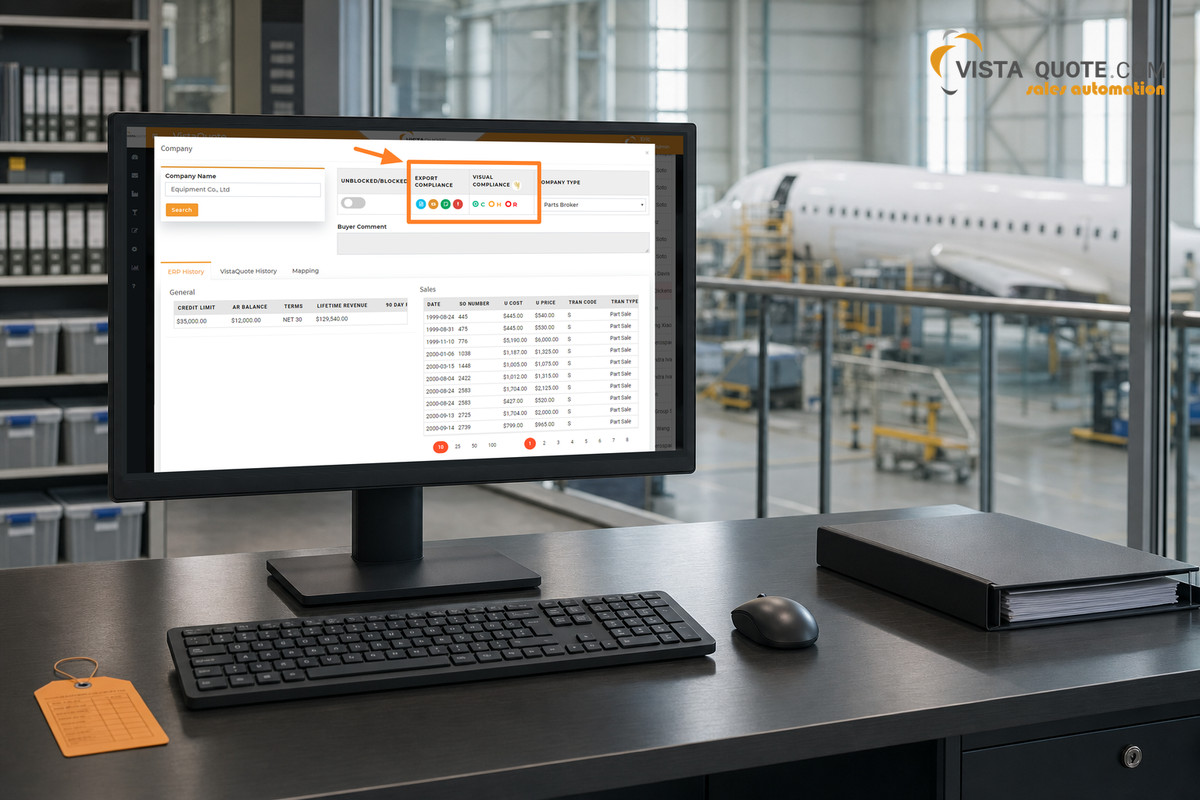
Export-compliance screening can now be part of receiving and working the RFQ instead of a disconnected task remembered after sourcing or pricing has already happened. The person handling the inquiry can spot possible screening concerns earlier, know when to request compliance review, and decide whether to continue sourcing and pricing the RFQ.
Vista-Quote does not replace your export-control procedures or the people responsible for them. Instead, it helps move screening due diligence closer to the first decision in the fulfillment process:
- Identify RFQs that may need review before sourcing or pricing begins.
- Give sales teams a clearer point for pausing, routing, or escalating an inquiry.
- Make the frontend process easier to manage, document, and explain.
For aviation sales operations managing a steady flow of domestic and international inquiries, this approach keeps compliance screening aligned with the work that begins each quote. The Descartes VisualCompliance service requires a separate subscription; however, Vista-Quote customers can qualify for reduced partner pricing.
See how restricted third-party export compliance screening can strengthen your workflow by giving your team clearer information earlier in the quoting process. Schedule a live Vista-Quote demo.
More about Descartes Export Compliance Screening in Vista-Quote
What Does Export-Compliance Screening Add to RFQ Management?
It adds an early compliance signal about transaction parties before the sales team invests more effort in sourcing, pricing, and logistics. The result should be handled under your organization’s own compliance and escalation procedures.
Can Vista-Quote Screen Incoming RFQs Automatically?
Yes. When the optional screening feature is enabled, Vista-Quote can automatically perform export-compliance screening on incoming RFQs through its integration with Descartes VisualCompliance. Manual screening is also available.
Does a Screening Result Decide Whether a Transaction May Proceed?
No. Screening is one input to review. It does not by itself resolve product classification, licensing, end-use, end-user, destination, sanctions, or due-diligence requirements.
Does the Descartes VisualCompliance Connection Require Another Subscription?
Yes. The Vista-Quote product page states that this feature requires a separate Descartes VisualCompliance subscription; however, Vista-Quote customers can qualify for reduced partner pricing.