


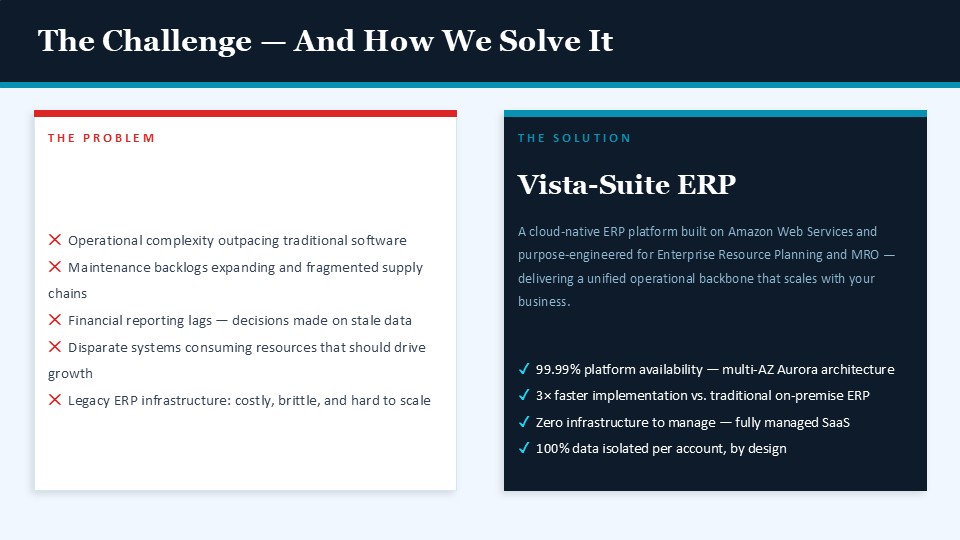
For years, aviation aftermarket and MRO companies treated ERP infrastructure as an IT ownership question. Should the system run on company-managed servers? Who patches the database? Who monitors backups? Who handles performance problems when activity spikes? Those questions still matter, but now there is much more to consider.
Aviation ERP software is not a passive administrative system. It carries the records, transactions, and decision points behind quotes, purchase orders, repair orders, work orders, inventory, receiving, shipping, invoicing, reporting, and customer communication. If that environment is difficult to secure, slow to extend, hard to integrate, or dependent on narrow infrastructure expertise, the limitation does not stay inside IT. It becomes a constraint on the business.
The first shift was from on-premise infrastructure to cloud ERP. The next shift is more important: understanding that not every cloud-based aviation ERP gives operators the same foundation. A system can run in the cloud and still carry weak reporting habits, brittle connection paths, limited governance, or technical decisions that do not fit the pace of aviation work.
Cloud ERP Alone Does Not Solve Underlying Operational Problems
Moving away from company-managed servers can reduce a massive burden. Hardware refreshes, operating system maintenance, database administration, backup monitoring, security work, and upgrade planning all consume time. Some of that cost is visible and some is hidden behind delayed IT projects, constrained reporting, limited connectivity, and dependence on a small number of people who understand the old environment.
Simply moving to a cloud-based ERP can still leave the business with old operating habits in a new environment. Reporting may compete with transaction activity. Outside systems may still require manual bridges. Inbound information may still lack a governed path. Access control may still behave like a basic login screen. In those cases, the business has gained cloud deployment without gaining the full value of a managed SaaS ERP architecture.
That distinction matters in aviation because ERP modernization is rarely about one department. An aviation aftermarket ERP platform supporting parts trading, distribution, repair activity, procurement, inventory movement, and financial transactions becomes part of the company’s operating capacity. The underlying platform influences how easily the business can scale, connect systems, report, and maintain continuity.
It is critical to examine the design behind the cloud claim and whether it was built to reflect how aviation companies actually operate.
What Strong Aviation ERP Infrastructure Should Protect
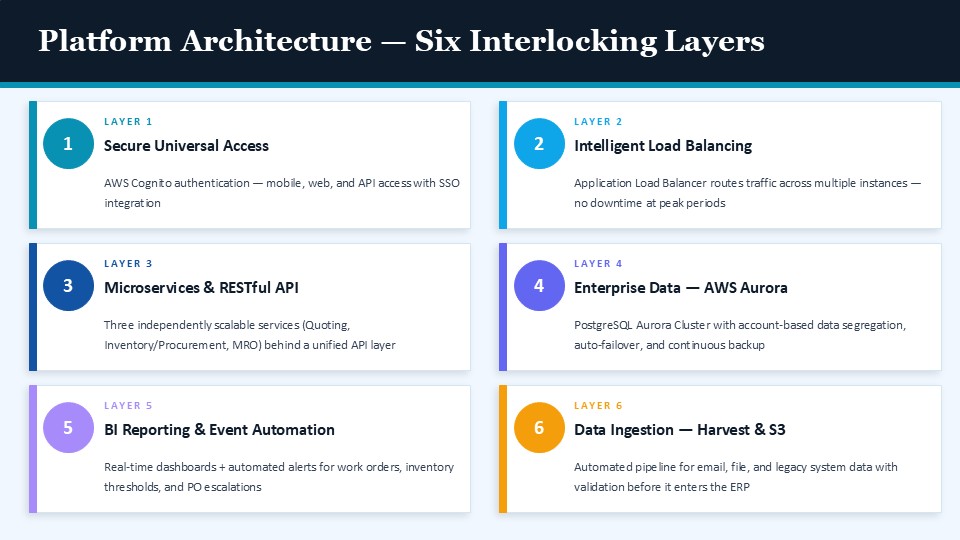
1. Secure Access That Matches Real Operating Patterns
Users may work through browsers, mobile devices, and connected systems. Managers may need current information away from a fixed office location. API access may be required for surrounding systems. Single Sign-On (SSO), role-based access, OAuth2-style authentication, and TLS-protected connections help keep each path governed through the approved environment.
2. Resilience During Active Business Periods
Aviation activity is unpredictable. RFQ volume can rise sharply. Procurement can cluster around repair demand. Receiving and shipping can create bursts of transaction activity. Financial review still needs to continue while operational work is active. MRO ERP software should use patterns such as load balancing, PostgreSQL database availability, backup, and recovery planning to absorb that workload as part of normal operations.
3. Management Visibility That Supports Leadership Without Disrupting The Operation
Decision makers need up-to-date views of maintenance costs, inventory movement, procurement activity, open transactions, financial performance, and operational exceptions. Business Intelligence (BI) dashboards, scheduled reports, and event automation are most useful when analytical activity does not slow the transactional system.
4. ERP Integration And Data Movement With Control
Aviation companies rarely run one system in isolation. Accounting, supplier data, storefronts, customer portals, business intelligence tools, historical records, and external data sources may all matter. API integration, data ingestion, validation, and account-based data segregation help keep those connections and inputs from creating cleanup work downstream.
This is where cloud quality begins to separate. Stronger design produces a stronger operating result: secure access, dependable performance, useful visibility, governed data movement, cleaner connection paths, and less infrastructure burden on the customer.
The Importance Of Operational Feature Fit
It is essential that aviation ERP software is compatible with your workflows for quotes, purchasing, inventory, repair activities, work orders, shipping, receiving, and financial execution. The underlying platform determines whether those workflows can stay dependable as users, transaction volume, visibility needs, outside-system demands, and governance requirements expand.
Evaluating cloud-based aviation ERP through operating outcomes cannot be ignored. Does the platform reduce internal infrastructure burden? Does it support secure access without encouraging side channels? Can dashboards inform leadership without creating drag on the transaction environment? Can outside systems connect through governed API paths? Can inbound information be validated before it becomes part of the operating record? Can the platform support ERP business continuity without making local IT the backstop for every risk?
These questions uncover meaningful differences that can easily hide behind technical jargon. Some systems run in the cloud, but on a virtual machine through a remote desktop configuration. Others are designed with foundational cloud-native access, Amazon Web Services (AWS) infrastructure, resilience, scale, reporting, REST API integration, and governance. For aviation organizations, that positive difference shows up in daily routine through fewer platform distractions, fewer manual bridges, cleaner visibility, and a stronger foundation for growth.
All That And More: Vista-Suite Enterprise Is The Right Choice
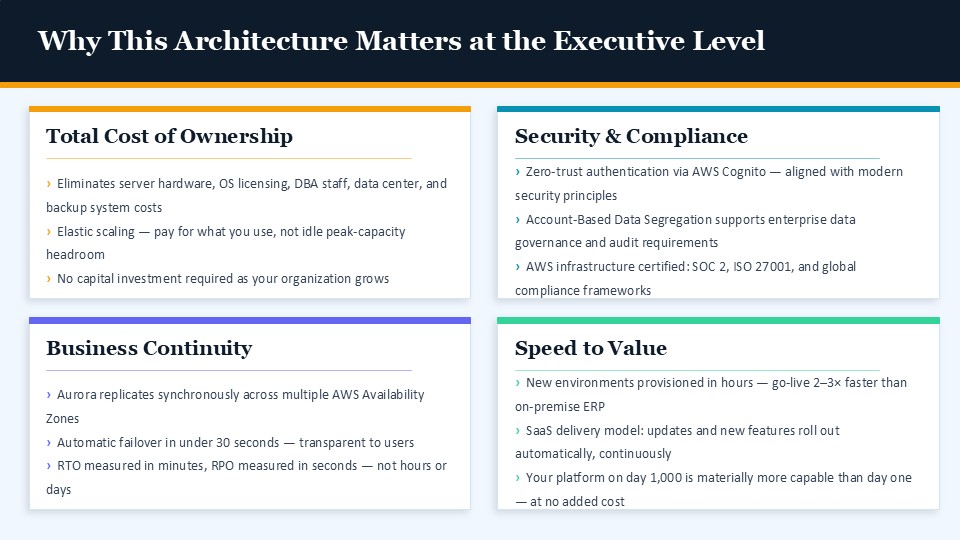
Vista-Suite Enterprise is a cloud-native aviation ERP/MRO platform for aviation-focused operators, including parts traders, distributors, brokers, Part 145 repair stations, and aircraft maintenance teams. Its managed AWS cloud architecture is designed to support secure access, resilience, REST API integration, reporting automation, data governance, and lower infrastructure burden.
Our cloud-based aviation ERP offers the ultimate operating foundation. Strong aviation ERP infrastructure supports secure access, dependable performance, clean connections, current visibility, governed data movement, and reduced platform friction as the business grows.
Secure access, SSO, OAuth2-style authentication, TLS protection, and role-based controls support the way people and connected systems need to work. Load balancing and database availability protect the transaction environment when business activity is concentrated. BI dashboards and event automation support real-time management visibility.
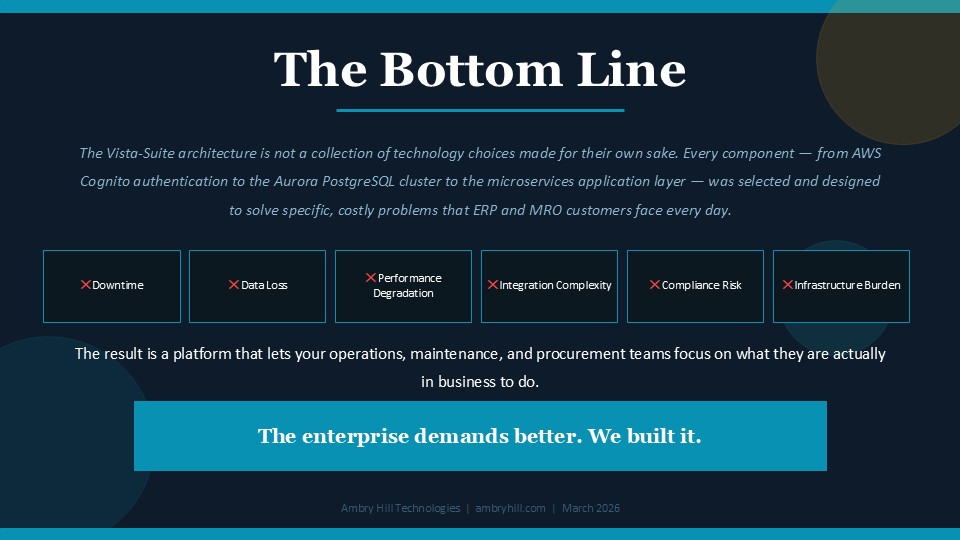
Vista-Suite Enterprise is built to reduce infrastructure burdens such as server management, reporting constraints, manual system bridges, and weak data flow while supporting the aviation workflows the business depends on every day.
To explore how Vista-Suite Enterprise supports aviation ERP and MRO operations on a managed cloud architecture, schedule a live demo at ambryhill.com/demo.
FAQ
What is cloud-based aviation ERP?
Cloud-based aviation ERP is enterprise resource planning software delivered through managed cloud infrastructure and designed to support aviation workflows such as quoting, purchasing, inventory, repair orders, work orders, shipping, receiving, invoicing, reporting, and mobile access.
Why does ERP infrastructure matter for aviation aftermarket and MRO companies?
ERP infrastructure affects continuity, security, reporting performance, integration readiness, data governance, and IT burden. In aviation operations, those factors influence how reliably the business can run transactions, view current information, and support growth.
What should executives ask about ERP architecture?
Executives should ask how the system handles secure access, resilience, backup, reporting workloads, data segregation, API integrations, and controlled data ingestion. These questions reveal whether the platform can support the business beyond the initial feature list.
How does cloud ERP support business continuity?
Cloud ERP can support business continuity through managed infrastructure, resilient application delivery, database availability planning, backup and recovery capabilities, and reduced dependence on local server maintenance.
Why do integrations and reporting architecture matter in aviation ERP?
Integrations and reporting architecture matter because aviation companies often need connected systems and current visibility. Manual exports and strained infrastructure can turn the ERP into a bottleneck for the operation.