


Any Enterprise Resource Planning (ERP) system can move a clean quote into an order and then into an invoice, but the meaningful test begins when the accepted core changes, the repair scope is still unknown, export information needs review, or a new charge appears after the order is already moving.
At that point, the software either keeps the part, cost, approval, and customer commitment together, or it distributes the explanation across separate records. If separated, exchange terms might remain in the quote, receipt details in local notes, export information in a separate review, repair scope in the work order, and added costs in invoice preparation. Each detail may exist, but no single record explains how the transaction changed.
Aviation software should handle those exceptions without requiring a later step to reconstruct an earlier decision. Additional fields are not enough; the quote, receipt details, export review, work order, and added charges should retain their relationships as the deal changes.
The Core Changed, Now There Are Two Versions of the Same Deal
Exchange terms often change after the original quote. A customer may be allowed to return a PMA, an alternate, or a superseded part, while a multi-unit exchange may include different conditions, repair exposure, and core values on the same order. Some software systems have rigid order lines that cannot represent those differences without being split, annotated, or supported by a separate schedule.
Splitting the order may solve the immediate entry problem, but it weakens the history needed during receipt, repair, crediting, and invoice review. A returned core can move through inspection, a work order, outside repair, credit, a replacement charge, or conversion to an outright transaction, and each move changes ownership or cost without changing the commercial reason the unit is there.
The order should retain nuance as the core changes. Otherwise, receipt processing depends on interpreting quote notes, later reconciliation depends on separate entries, and the customer receives an explanation assembled after the fact. Preserving the agreement is the first requirement, but the part should also carry the information forward for the next operational decision.
Export Compliance Data Should Be Where the Release Decision Happens
Export compliance data can be complete yet operationally absent. An ECCN stored in a part master does not help at inspection or release if the data field disappears from the screen used for that decision. The same problem applies to HTS, country of origin, end-use documents, license details, and screening results.
The key concern is not if the company has stored the information, but whether a restricted status is visible prior to order acceptance, whether classification and origin details are available at receipt, and if customs values can be accessed before release without needing a separate search.
Responsibility for export review varies by company, but the operational requirements do not: the relevant fields, warnings, and review history must appear when the part is accepted or released. Keeping that information attached to the part prevents the commercial agreement and the release decision from drifting apart. The work order poses a similar challenge because the system must maintain what is known without assuming that the unknown repair scope has been previously determined.
When A Repair Quote Requires a Task That Doesn’t Exist Yet
A repair quote and a work-order task answer different questions. The quote defines the commercial scope that is known at that point: what can be priced, what remains an estimate, and what may require customer approval. A task defines maintenance work that is ready to be assigned, performed, tracked, and, when required, signed off.
The information needed for each is not available at the same time. Before teardown and inspection, the known scope may include an evaluation charge, estimated labor, material allowances, freight, or outside service, while the individual repair steps remain unknown. But does that make the quote incomplete? Not necessarily, since it accurately reflects how much can be established before the unit is opened and the findings are documented.
The trouble is when software requires a task merely to hold the estimate. A broad placeholder gives the amount somewhere to sit, but it also makes the work order appear more specific than the shop can knowingly support. For example, once teardown activities establish the actual repair scope, repair tasks are added for the work, but the placeholder remains active until it is closed or separated from the new labor, materials, and charges. The completed work order now mixes a line created to hold an early estimate with tasks that describe the actual repair.
Vista-Suite Enterprise’s cleaner structure keeps whole-job estimates at the work-order level and creates tasks when the work needs its own assignment, status, instructions, sign-off, or technical history. If inspection changes the expected price, the quote can be revised and the approval retained without inventing maintenance work to support the earlier estimate. Each entry then has a clear purpose, and invoice review can distinguish whole-job costs from amounts tied to specific repair tasks.
Explanation of Charges for Accurate Invoicing
Freight, hazmat handling, crate building, inspection, repair, core, and replacement charges are generally known before invoice review. However, billing becomes a headache when the amount is listed without the corresponding item details, transaction history, ownership information, or other relevant data.
A generic charge code retains the dollar amount but loses the explanation behind it. Therefore, accurate invoicing involves searching notes, identifying the affected unit, and confirming whether the charge was authorized. The invoice process stalls as people reconstruct the original decision at the time the cost was incurred.
Invoice accuracy starts at the moment the charge is recorded, because the exchange, part, and work order must preserve the accepted core details, export information, job-level costs, and the event that made the amount billable.
There is a better way. Vista-Suite Enterprise provides a workflow that ensures jobs are accurately maintained from the start, so invoices reflect this history in real time, saving you the trouble of recreating it later.
How Vista-Suite Enterprise Preserves Transaction Integrity
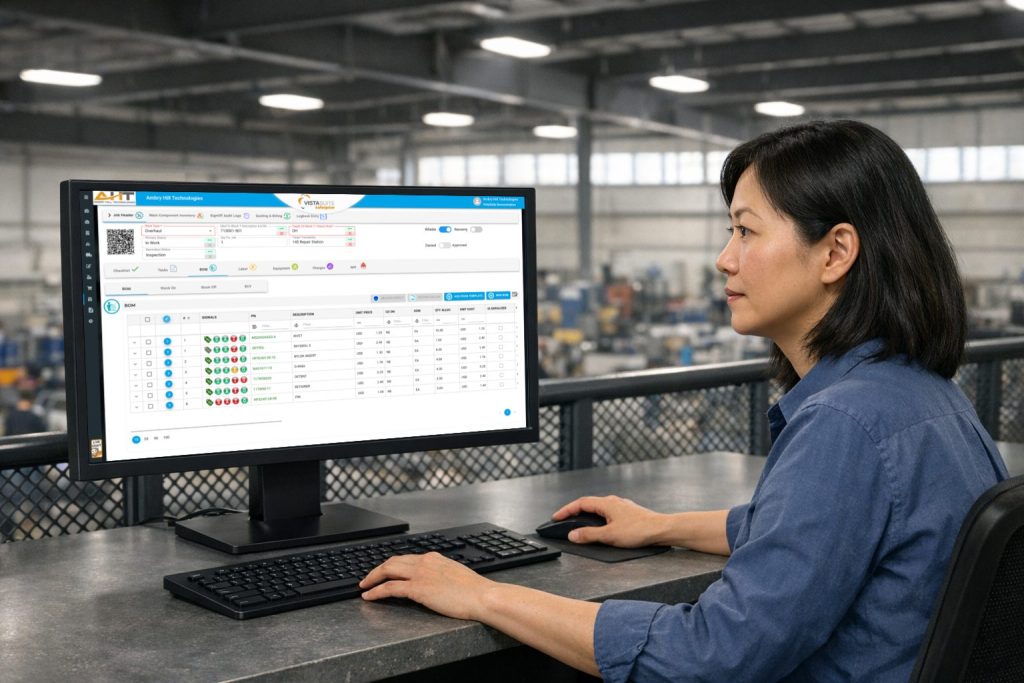
Vista-Suite Enterprise keeps return-core expectations, alternate-part options, costs, credits, and replacement charges inside the exchange transaction. Related inventory and historical details remain accessible as the returned unit moves into inspection or repair.
Export details such as ECCN, HTS, origin, and related fields can remain available across the part master, receipt, shipment, invoice, and reporting areas. As an extra layer of due diligence, a Descartes VisualCompliance integration supports denied-party screening when separately subscribed.
While an approved customer quote can be converted into a work order, when teardown or inspection drives a more complex estimate, quote details can also begin in the work order and move to a customer quote.
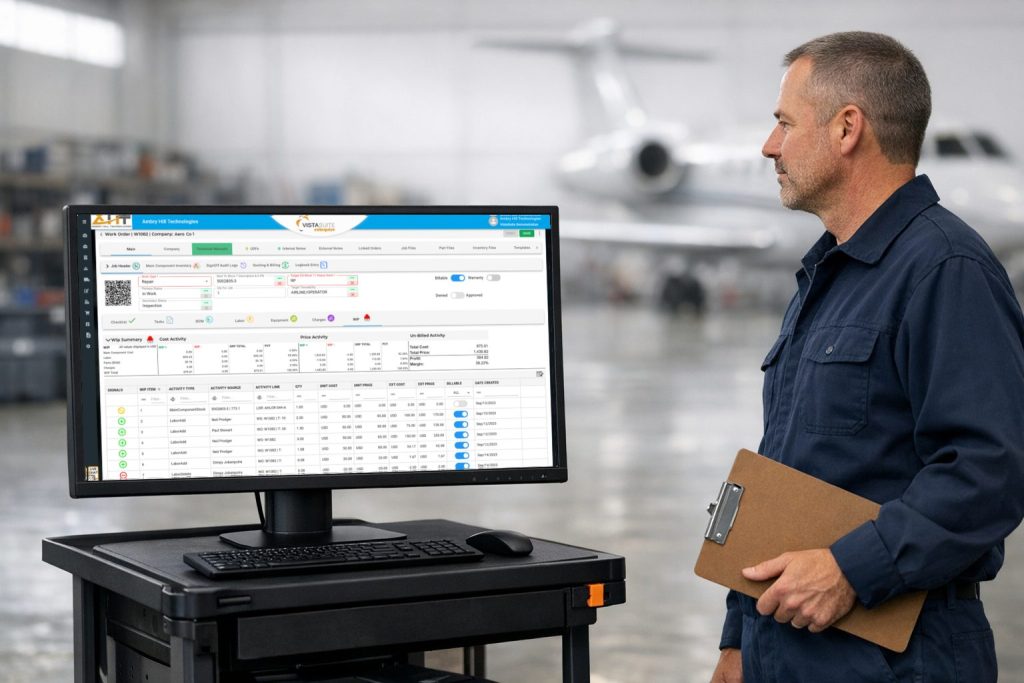
Labor, bill-of-material items, and ad hoc charges can be recorded at the work-order header without a supporting task. Those entries appear in the work-in-progress (WIP) log alongside task-level costs, keeping the complete job cost available for operational and invoice review without adding maintenance steps that were never performed.
Part-related repair, core, and over-and-above charges can stay associated with the relevant part and transaction history. Freight and miscellaneous costs have defined transaction fields, while linked-order access provides a direct path back to the order that produced the amount.
To see how Vista-Suite Enterprise can benefit your company, request a live demo at ambryhill.com/demo
More About What Makes Vista-Suite Enterprise the Best Alternative to Legacy Aviation ERP/MRO Software
What indicates whether aviation ERP software is a good fit for an aftermarket operation?
One major, meaningful test is whether the system can preserve the part, cost, approval, and customer commitment when an exchange, repair, shipment, or charge departs from the standard path.
Why should export data appear at receipt and release?
Classification, origin, license, and screening information support different decisions during order acceptance, receipt, routing, and release. The relevant data needs to be available at each decision point without requiring a separate search.
Should a repair quote require a work-order task?
Not when the shop is estimating known job-level scope before teardown or inspection defines the maintenance tasks. A task should represent work that needs assignment, control, sign-off, or technical history.
How do disconnected charges create revenue gaps?
A charge can be known and entered but still miss the invoice when its relationship to the part, exchange line, repair, or approval is unclear. Invoice preparation then depends on research and memory, increasing the chance of delay, dispute, or write-off.